

AI amplifies whatever it's pointed at. Point it at a well-run firm and it compounds the advantage. Point it at chaos and it produces faster, more confident chaos.
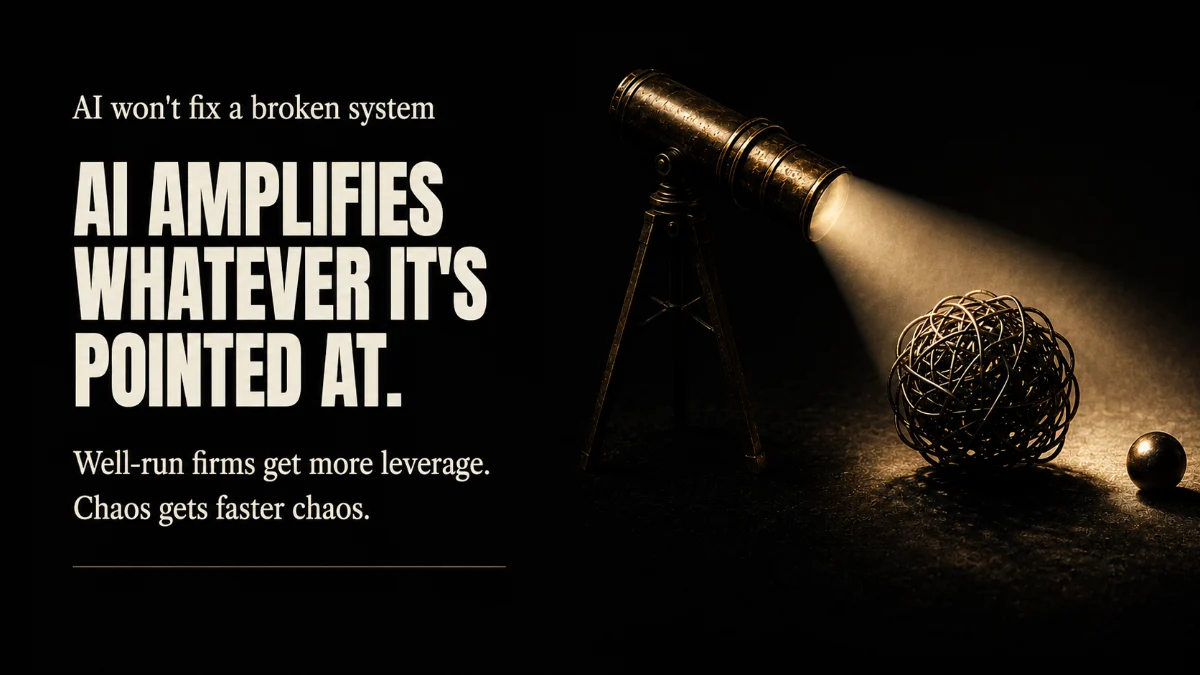
AI doesn't repair weak foundations — it magnifies them. Before AI pays off, a firm needs clean structured data, workflows that exist in the system rather than in people's heads, consistent documents, and governance. Firms that fix the foundation first get compounding returns; firms that skip it get expensive disappointment.
Every firm we speak to now has AI on the agenda. That's the right instinct — the capability is real and it's arriving inside the platforms firms already run. But there's a pattern worth naming before you spend a dollar on it.
AI is not a corrective technology. It doesn't repair a weak process, reconcile inconsistent data or supply a decision nobody has made. It takes whatever it's given and does more of it, faster. Which means the firms that get the most from AI are the ones that needed it least — and the firms hoping it will paper over a mess get an expensive, confident version of that mess.
Four things, and none of them are AI:
Because it's less exciting, and because the pitch is always that the AI will handle it. Foundation work is unglamorous — data cleansing, workflow design, template rebuilds. AI demos beautifully. So firms buy the demo and discover the gap afterwards, usually about six weeks in, when the team quietly stops using it.
There's also a measurement problem. Foundation work pays back in ways that are easy to feel and hard to attribute: fewer errors, less re-keying, faster onboarding. AI arrives with a number attached. That makes it easier to approve and harder to evaluate honestly.
We call it foundation first, then AI, and in practice it's shorter than it sounds — because you don't need the whole firm in order, only the process you're starting with.
The useful side effect: the foundation work delivers value on its own. If the AI step turns out to be less transformative than promised, you've still removed manual work, reduced error and made the firm easier to run. That's not a consolation prize — for most firms it's the larger share of the benefit.
Before you buy anything, ask what would happen if the AI were switched off tomorrow. If the answer is that the firm reverts to something that already worked reasonably well, you've built on a foundation. If the answer is that nobody's quite sure how that process ran before, you've built on sand.
We're not AI sceptics — we build it into firms and it earns its place. We're sceptical of AI as a substitute for the unglamorous work underneath it. Get the foundation right and AI compounds it. Skip the foundation and AI just gets you to the wrong answer sooner.
No — perfect isn't the bar, and waiting has its own cost. The bar is that the specific process you're pointing AI at has clean data and a defined workflow. You can meet that for one process in weeks while the rest of the firm catches up.
The AI is asked to work with data it can't rely on. If matter records are inconsistent, documents unstructured and process undefined, the output can't be trusted — and once people stop trusting it, adoption is finished regardless of how good the tool is.
Rarely. Most firms already own a capable platform that's underconfigured. Finishing what you have is almost always faster and cheaper than replacing it, and it's exactly the groundwork AI needs.