

If that question gets asked a dozen times a day in your firm, the problem isn't your team. It's that the status lives in inboxes, not your system.
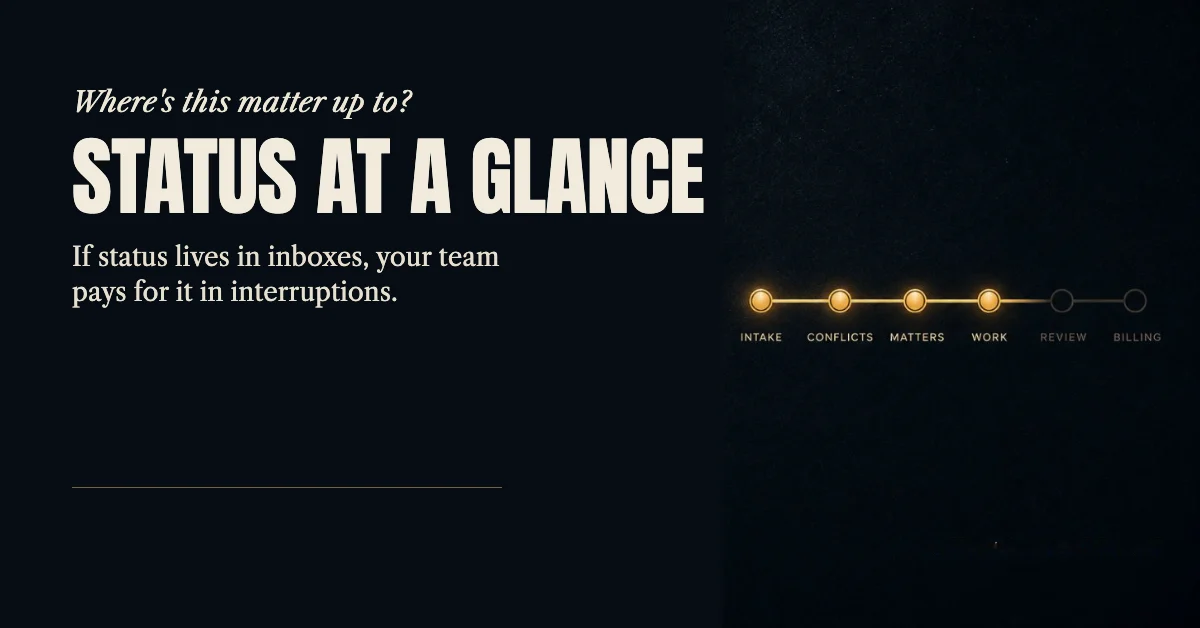
A well-built matter workflow defines every stage, triggers every task automatically and tracks every handoff — so anyone can see where a matter is up to without asking. Interruptions stop, nothing slips, and the principal gets oversight of the whole practice on one screen.
Every firm has the ritual. Someone needs to know where a matter is up to, so they interrupt the person running it, who stops what they're doing to remember, check their inbox, and answer. Multiply that by every matter and every day, and you've got a firm running on interruptions.
It's not a people problem. It's a visibility problem — and it's exactly what a well-built workflow solves.
End-to-end matter workflows inside your practice management system: every stage defined, every task triggered automatically, every handoff tracked. The matter moves itself through a known path, and anyone — principal, paralegal, client-facing lawyer — can see where it's up to at a glance. When matters run on rails like this, they also move measurably faster.
Three things change. The interruptions stop, so fee earners get their focus back. Nothing slips, because the workflow won't let a stage be skipped or a task forgotten. And the principal gets oversight of the whole practice on one screen, instead of reconstructing it from conversations.
There's a quieter benefit too: consistency. When every matter of a type follows the same workflow, the firm stops depending on heroics and starts depending on process — and new staff get productive faster because they're following rails, not absorbing tribal knowledge.
The work was always sitting in your practice management system. We just make the system actually manage the practice.
With the matter type that generates the most “where are we up to?” questions. It's usually your highest-volume work, and it's where visibility pays back fastest.
Good workflows carry the routine and leave judgement to the lawyer. If a workflow feels like a straitjacket, it's been built around the software instead of around how the firm actually works.